Takashi Murakami JP, b. 1962

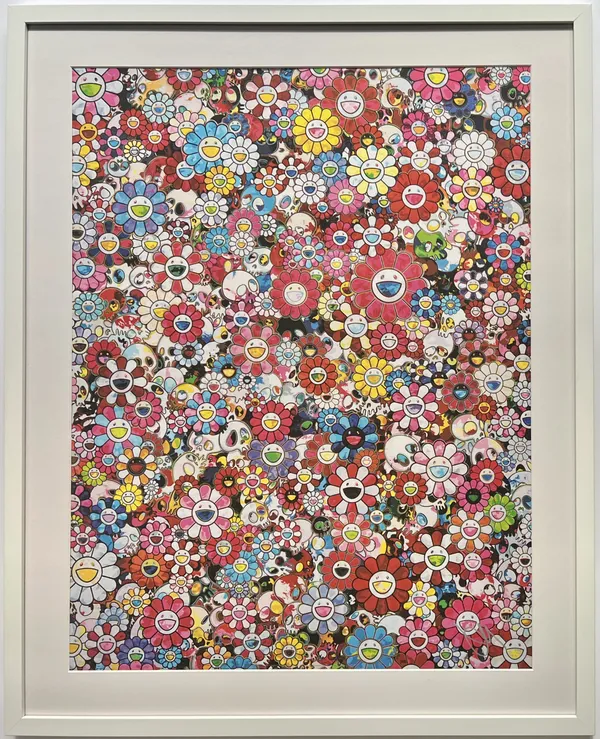
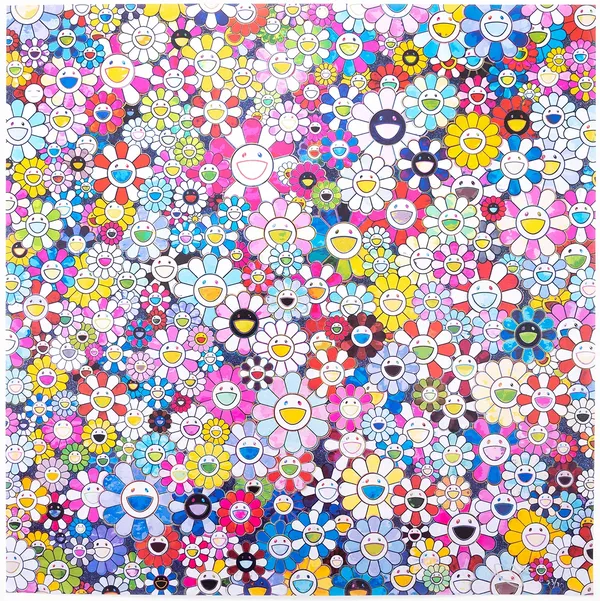
Takashi Murakami’s work is created at the intersection of Japanese art history, post-war visual culture, and global pop aesthetics. His celebrated paintings, sculptures, digital works, and large-scale installations bring together smiling flowers, metamorphic characters, and intricately patterned surfaces rendered with the immaculate finish of industrial production.
Beneath this seductive visual exuberance, however, lies a sustained critical intelligence. Murakami’s signature flatness is not merely a decorative device but a deliberate conceptual strategy rooted in the two-dimensional traditions of classical Japanese painting and rearticulated as a profound meditation on post-war Japanese identity, consumer culture, and the politics of image-making. Through his studio practice and international production network, he has shaped a distinctive visual language capable of registering the psychic conditions of contemporary Japan with remarkable precision.
Born in Tokyo in 1962, Murakami developed an early fascination with anime, manga, and the vitality of popular culture before entering the Tokyo University of the Arts, where he trained in nihonga, the rigorous Japanese painting tradition on silk and paper using natural pigments. He completed his BA, MFA, and PhD at the institution, and this grounding in traditional Japanese art proved to be not an endpoint but a foundation for innovation. The flattened space and decorative exactitude of nihonga allowed him to trace a lineage from Edo-period screen painting to the graphic languages of manga and anime, establishing the aesthetic and historical framework for his later work.
A formative period in New York in the mid-1990s, supported by a residency at P.S.1 Contemporary Art Centre, further sharpened his engagement with Western contemporary art discourse and reinforced his determination to articulate a distinctly Japanese model of contemporary art. In 2001, he founded Kaikai Kiki Co., Ltd., a studio and production company dedicated to making his own work and supporting younger Japanese artists—a structure that consciously echoes, while critically revising, the commercial model of Andy Warhol’s Factory.
Murakami’s most influential theoretical contribution is Superflat, the movement and manifesto he introduced in 2001. Superflat proposes the two-dimensionality of Japanese visual culture as both an aesthetic inheritance and a critical framework for understanding the social and historical condition of post-war Japan. In contrast to the cool detachment of American Pop Art, as exemplified by Andy Warhol and Roy Lichtenstein, Murakami’s practice is more historically situated and more culturally specific, drawing on Edo-period masters such as Ogata Kōrin, the visual language of ukiyo-e, and the ironic surface of otaku culture, while also addressing the lingering psychological legacy of the American occupation.
Now represented in major museum collections and widely discussed in scholarship on contemporary Japanese art, Murakami has become one of the most influential artists of the late twentieth and early twenty-first centuries, with an impact felt across fine art, fashion, design, luxury brand collaborations, and global visual culture.